Featured News

What Causes Neurodegenerative Diseases?

Human Health

Genetic and Environmental Factors Play a Role 
Neurodegenerative diseases involve the progressive degeneration of nerve cells, causing cognitive and motor impairments. Though often thought of as age-related diseases, genetic predisposition and environmental factors can also play a significant role as the causes of neurodegenerative diseases. Read more about these diseases at “Understanding Neurodegenerative Diseases.”  

The enteric nervous system (ENS) is a large division of the peripheral nervous system (PNS) that controls gastrointestinal functions and is often called the “second brain” because of its complexity and ability to function independently. The loss, degeneration, or functional impairment of neurons in the enteric system can lead to varied gastrointestinal disorders and has been increasingly linked to various neurological disorders and neurodegenerative conditions that can develop throughout a person’s life.   

One disease of the ENS called Hirschsprung’s Disease is relatively common, impacting one in 5,000 babies who are born with it. This congenital condition affects the baby’s large intestine, where neurons (ganglion cells) are absent in the colon, leading to a lack of normal muscle movement. This condition results in constipation, abdominal distension, and difficulty passing stool, as well as abnormal secretion and absorption that occurs during the digestion of food. Because of this disruption, the milk or formula that newborns consume cannot successfully pass down the gut. This can result in distension of their belly, bilious and bloody vomiting, and even death of the baby, all due to this relatively common problem of the ENS. 

Another disease that can be associated the ENS as well as the CNS is Parkinson’s Disease, a condition characterized by tremors, rigidity, and bradykinesia. Only about five to 10 percent of patients with Parkinson’s are born genetically predisposed to it. Some researchers propose that Parkinson’s pathology may start in the ENS with gastrointestinal symptoms such as constipation, which may have potential as a biomarker for early diagnosis and be indicative of future CNS disorders. This theory then suggests that Parkinson’s is spread to the CNS via the vagus nerve, followed by the onset of motor symptoms. What about the other 90 percent who aren’t genetically predisposed to it? They have what is called idiopathic Parkinson’s, which is believed to result from exposure to various environmental factors, specifically toxins, which can include pesticides, fungicides, and herbicides.

 

Interested in learning more about how the nervous system functions, nature’s impact on the nervous systems of the living and the unborn, and where you might first experience signs of neurodegeneration? Listen to this episode of the Science Diction podcast from MRIGlobal!

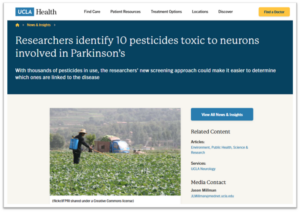
Researchers at UCLA Health and Harvard recently analyzed the exposure history of 288 pesticides among patients in the Central Valley of California with Parkinson’s, using data from previous studies. They tracked long-term pesticide exposure for each participant and conducted a “pesticide-wide association analysis,” testing each pesticide’s potential link to Parkinson’s. This analysis revealed 53 pesticides potentially associated with Parkinson’s, many of which had not been previously studied for this connection and are still in use. Further, these researchers found several pesticides that were directly toxic to dopaminergic neurons, which play a key role in voluntary movement, with the death of these neurons being a hallmark of Parkinson’s. This may point to those with greater exposure to these pesticides, such as farmworkers, being more likely to develop Parkinson’s later in life. Read more about their work at “Researchers identify 10 pesticides toxic to neurons involved in Parkinson’s.” 

Another example of Parkinson’s resulting from environmental factors is due to exposure to Agent Orange, an herbicide used during the Vietnam War. Agent Orange contained toxic dioxins, which can disrupt normal cell functioning and contribute to neurodegenerative diseases. Veterans and civilians exposed to this chemical have shown higher rates of Parkinson’s. Studies suggest that prolonged exposure to dioxins may increase the risk of developing Parkinson’s due to their ability to damage the nervous system. Ongoing research seeks to better understand the full extent of Agent Orange’s long-term effects on health. Read more in this “Agent Orange Exposure and Dementia Diagnosis in US Veterans of the Vietnam Era” research, published by scientists from the San Francisco Veterans Affairs Health Care System, The Veterans Health Research Institute, and University of California at San Francisco, among others.

GETTING STARTED AT MRIGLOBAL
Contact MRIGlobal for further information about our work to improve human healthThrough a multidisciplinary approach, we provide customized research for commercial and government customers. This includes expertise in pharmaceutical sciences, health surveillance and diagnostics, and engineering.   

SIGN UP FOR OUR NEWSLETTER
Sign up for the MRIGlobal newsletter! It’s the best way to get the latest updates in the world of applied scientific engineering research delivered directly to your inbox.