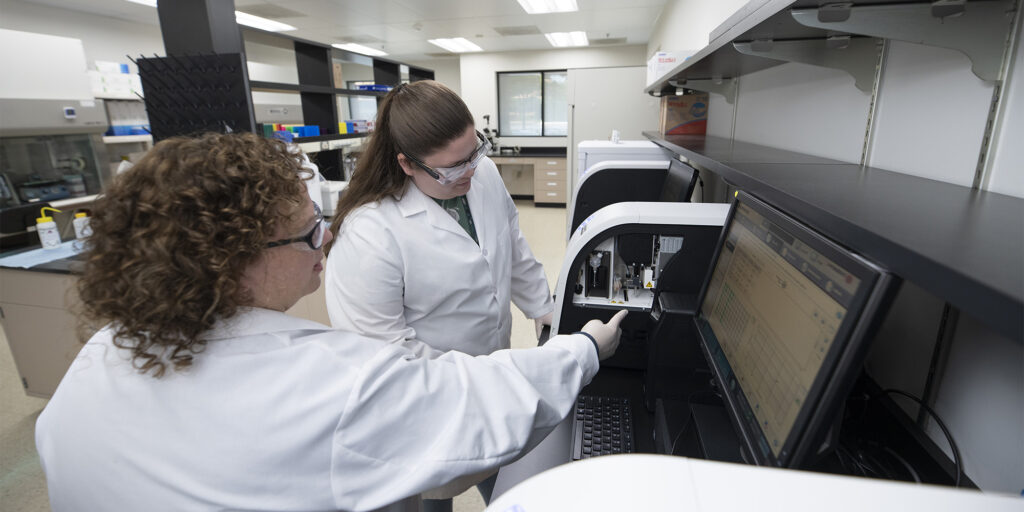

Celebrating International Day of Women & Girls in Science
Tuesday, February 11, is International Day of Women & Girls in Science and allows us to honor women’s significant achievements in science and place a much-needed focus on girls entering Science, Technology, Engineering, and Mathematics (STEM) careers.
For more than 80 years, MRIGlobal’s scientific research contributions have been advancing knowledge and shaping the world. These are but two of our many scientists who are women whom we celebrate.
Chelsey Smith, Ph.D.
Growing up, Chelsey Smith, Ph.D., loved math and science. Early on, exploration of the world around her was fostered by learning how things worked. Later, she found joy in solving complex problems in the logic puzzle books she received as Christmas gifts. Through high school and then college, she knew she wanted to use her combined interests in math and science to help people.
While earning her Ph.D. in bioengineering from Rice University, Smith began using her expertise to create technologies that can save lives. “I saw that degree as translational, bridging math, engineering, and science with the application to help people,” says Smith. During her time at Rice, she chose to work in a laboratory that supported global health, designing point-of-care tests for cancer, HPV, and then COVID-19. Their goal was to create portable diagnostics that could help make care accessible in rural areas where traditional testing was not always available.
Today, Smith’s work at MRIGlobal is focused on research and development to address important diagnostic and biosurveillance challenges. Her involvement in the DARPA DIGET program, supporting development of a massively multiplexed detection (MMD) device, will enable early threat detection, assess disease severity, and improve situational awareness. The MMD platform will also provide actionable data for biosurveillance efforts such as characterization of known and emergent pathogens in circulation to inform countermeasure deployment. In addition, Smith and her team are working to speed the developmental timeline from disease discovery to diagnostic test using rapid reconfiguration.
Smith encourages girls and women to pursue careers in STEM, saying that being a part of her team, which is mainly women, is extremely rewarding. “I love working together to make a difference, help others, and address important national security challenges.”
Alison Hart, Ph.D.
Similar to Smith, Hart was good at math and science from a young age, also enjoying logic puzzles and figuring out how things worked. After turning 16, Hart moved to England, where she says she had a fantastic chemistry teacher. Dr. Barber fit the scientist stereotype with a shock of white hair, glasses, a love for Bob Marley, and a passion for science. This was Hart’s first exposure to chemistry and his enthusiasm for the topic made it engaging and fun, driving interest in her future career.
This developed into finding joy in a subject that students often revile – organic chemistry. She says, “Everyone hated it, but I liked the memorization and strict rules. I found that I could put things together and get the results I wanted.” Following dual undergraduate degrees in chemistry and applied mathematics, Hart earned her Ph.D. in chemistry at the University of Southern Mississippi, specializing in organic synthesis and methodology.
“We optimized reaction pathways, which fulfilled the wanna-be engineer side of me.” She says, “This led to process chemistry, which is very method driven, putting a reaction together to see what happens. With so many choices of acids, bases, solvents, temperature, flow rate, and other variables, it was interesting to see which reactions worked and which didn’t.”
With MRIGlobal, Hart’s work is focused on developing multiple steps for synthetic routes. This includes creating analogs for fentanyl, ketamine, and other substances used by MRIGlobal’s CBRN team to test drug detection equipment. Her work also includes optimizing the reaction pathways for pre-clinical pharmaceutical drugs that have been designed for the treatment of Alzheimer’s, ovarian cancer, glioblastoma, tuberculosis, and methamphetamine abuse. Optimizing the reaction pathways for synthesis on kilogram scale can help to reduce the cost to synthesize pharmaceuticals, thus keeping the price competitive and accessible for those in need.
For girls and women wanting to pursue a career in the field, Hart suggests, “Ask questions. It can be hard to ask because we don’t want to stand out, but the best way to learn is to ask. That curiosity enables growth.”