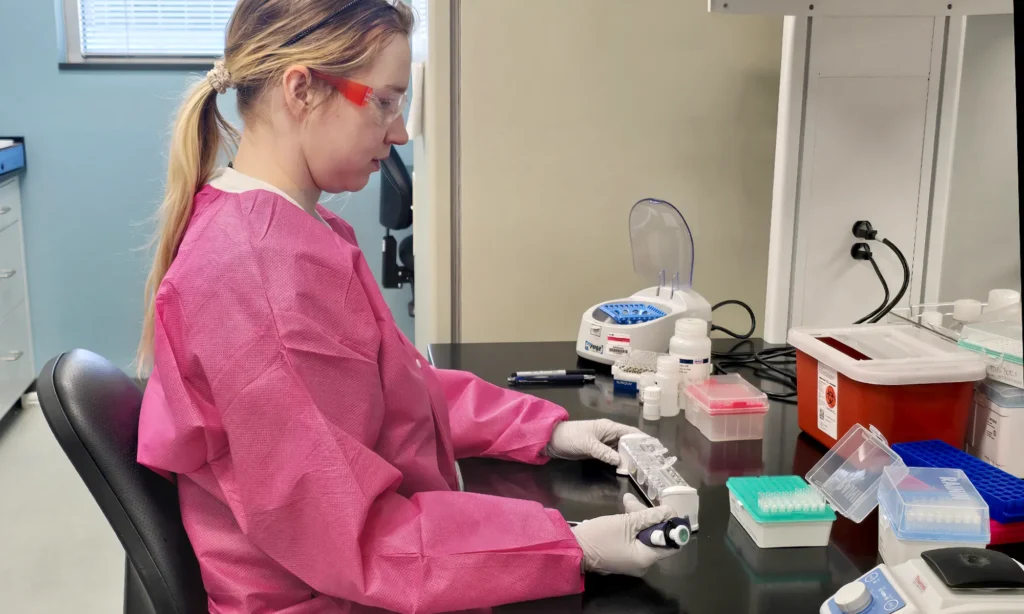

In Celebration of International Day of Women and Girls in Science
Sunday, February 11, marks the ninth International Day of Women and Girls in Science (IDWGS). Established in December 2015 by the United Nations General Assembly, the IDWGS aims “to recognize the critical role women and girls play in science and technology.” According to a UNESCO science report, globally, only one in three scientific researchers is female. The organizers of the IDWGS seek to foster environments that encourage girls and women to study scientific topics via mentorship, break down stereotypes about women in science, and raise awareness about the vital work women in science currently perform.
Dedicated to scientific advancement, MRIGlobal celebrates the many contributions our scientists make to improving people’s lives through innovative scientific and engineering research. Here, we profile three of their stories, honoring International Day of Women and Girls in Science.

Establishing Methods for New Technologies
Rachel Ginther joined MRIGlobal as a staff chemist and is now a program manager, and she suggests there’s a general lack of understanding among many young people about what careers in science are possible, aside from becoming a medical doctor. Even when she was in graduate school, Ginther notes she didn’t fully grasp the types of careers available outside of academia in industry. In order to develop and diversify the pipeline of future scientists, she believes it is necessary to reach out and share with young students the variety of places their interest in and affinity for science can lead them.
At MRIGlobal, Ginther has worked on various projects in pharmaceutical analysis, helping companies collect the quality data they need in order to put together FDA submissions. She currently works on a project involving CRISPR technology for gene editing.
CRISPR can cut DNA at specific targets, which enables scientists to modify the DNA to combat diseases. In December 2023, the FDA approved the first CRISPR/Cas9-based gene therapy for the treatment of sickle cell disease. Although the technology has been around for decades, Ginther emphasizes it is now emerging in its use as companies develop new drugs to aid patients.
Ginther is working to develop quality control methods for CRISPR-based drug products. Traditional drugs that have been around for a long time have established methods of analysis and quality control. Today, Ginther is working to establish new quality control methods for the emerging class of drugs. Ginther notes this project is challenging because it involves a guide RNA component and a Cas9 component, and these very different molecules have to complex together. Instead of having multiple different methods for each component and product, Ginther is developing a method to improve efficiencies so a researcher can determine the purity of both the CRISPR components as well as the finished drug product.
Fighting Pandemic and Rare Diseases
Tiffany Edwards is a staff scientist in MRIGlobal’s integrated health and diagnostics group. Among the projects she works on is analytical testing for diagnostic assays for SARS-CoV-2, influenza A, influenza B, monkeypox, and Hepatitis C. At-home tests to detect the virus that causes COVID-19 use lateral flow assays. Edwards evaluates these test devices under many scenarios to ensure their efficacy. She explains, “It’s so fun to see the test devices that we were testing just last year hit the shelves.”
Edwards came to MRIGlobal seeking a fast-paced environment where she would consistently face new challenges. Here, she has maintained her passion for translational research, but it now spans a wide array of projects. In addition to her work involving analytical testing, she’s involved in an ELISA (enzyme-linked immunosorbent assay) validation for a prion assay for a customer.
Prions are infectious proteins that, when triggered, can lead to rare, progressive neurodegenerative diseases. In addition to impacting livestock, prion diseases (such as mad cow disease) can affect humans, moving from the initial onset of symptoms to fatality rapidly, within as little as a year. The diseases progress from a loss of motor function to complete incapacitation, with patients eventually being unable to speak or eat.
Edwards and her team are working to validate an ELISA to test for prion burden, which would be used in a clinical trial to treat prion disease. Edwards excitedly says this is one of her favorite programs to work on both because it focuses on such a rare disease and because the program is entirely led by women. She notes this doesn’t happen often in science, and it’s a nice change of pace from previous programs she has worked on.